

Best medical speech recognition software and APIs in 2026
Medical speech recognition software turns clinical speech into accurate, structured notes. Compare the 8 best tools and APIs for 2026 on medical accuracy, streaming, BAA availability, and pricing.

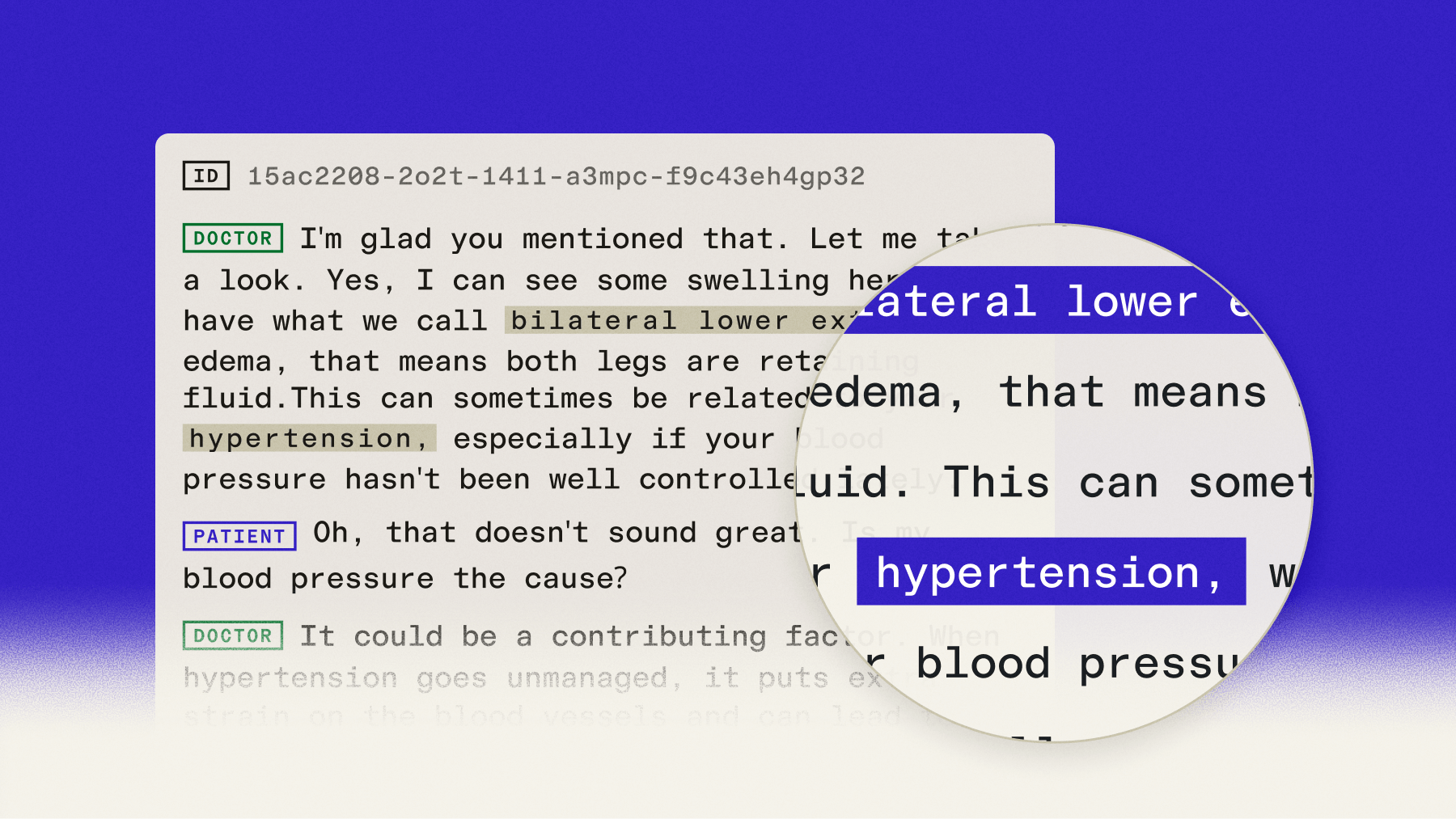

Two teams evaluate medical speech recognition the same week. One is a health system replacing dictation for 400 physicians. The other is a four-person startup building an ambient scribe for outpatient psychiatry. They read the same vendor pages, sit through the same demos, and end up in completely different places — because they were never shopping in the same market.
That's the first thing to get straight. "Medical speech recognition" covers two products that share a name and almost nothing else: packaged clinical documentation software you deploy to clinicians, and speech-to-text APIs you build a product on top of. Comparing Nuance DAX to a transcription API on price per hour is a category error, and it's the most common mistake we see in evaluations.
The second thing: the accuracy number that matters here isn't word error rate. It's Missed Entity Rate — how often the drug names, conditions, and procedures spoken in the room fail to appear in the transcript. A model can score beautifully on WER and still drop the medication list. That's the failure mode that ends pilots.
This guide covers both categories, the criteria that actually separate them, and the head-to-head comparisons buyers ask us about most.
What medical speech recognition actually is
Medical speech recognition is speech-to-text tuned for clinical language — pharmacological names, anatomical terms, procedure codes, abbreviations, and the dosage patterns that general models mangle. It shows up in three shapes.
Front-end dictation
A clinician speaks, text appears in a field, they correct it in real time. This is the Dragon lineage. It's mature, it's fast, and it puts the clinician in the loop for every word. The tradeoff is that the clinician is still doing documentation work — just with their voice instead of their hands.
Ambient clinical documentation
A device listens to the whole encounter and a note comes out the other side. Nobody dictates. The clinician talks to the patient. This is where the market has moved, and it's a much harder engineering problem: far-field audio, two or more speakers, conversational speech, and no chance for the clinician to correct as they go.
Speech-to-text APIs
The infrastructure layer. You send audio, you get a structured transcript with speaker labels and timestamps, and you build whatever sits on top — a scribe, a coding tool, a telehealth product, a QA workflow. This is the category if you're building rather than buying.
How to evaluate medical speech recognition
Six criteria decide most of these evaluations. In rough order of how much they matter:
1. Medical entity accuracy
Ask every vendor for Missed Entity Rate on drugs, conditions, and procedures, not overall WER. If they only publish WER, that's information too. Universal-3.5 Pro with Medical Mode enabled records a 3.2% Missed Entity Rate — the lowest across the providers we've benchmarked. Methodology is on our benchmarks page.
2. A signed BAA
If you're processing PHI, you need a Business Associate Addendum in place before a single real recording moves. Some vendors sign readily; some sign only above a spend threshold; some don't sign at all on self-serve tiers. Find out before you build.
3. Streaming versus pre-recorded
Front-end dictation needs streaming. An ambient scribe that generates the note after the visit doesn't, and pre-recorded transcription is both cheaper and more accurate. A lot of teams pay for streaming they never needed.
4. Diarization quality
An ambient scribe lives or dies on separating clinician from patient. Ask what metric the vendor optimizes: Diarization Error Rate scores how much audio time landed in the right bucket, which flatters systems that handle monologues and ignores dropped short turns. cpWER scores the words in each speaker's transcript, which is what your note generator consumes.
5. Language coverage
Two separate questions, frequently conflated. Can the model follow a conversation that switches languages mid-sentence, and is the clinical tuning available in the languages you serve? For us: the base model code-switches natively across 18 languages, while Medical Mode's clinical tuning covers English, Spanish, German, and French.
6. Integration model
Packaged scribes ship EHR connectors and charge per clinician per month. APIs charge per hour of audio and leave the EHR work to you. Neither is better; they're different bets on where your engineering time should go.
Medical speech recognition compared
Provider profiles
AssemblyAI
We build the API layer, not the scribe. Medical Mode is a single parameter — domain: "medical-v1" — applied on top of Universal-3.5 Pro for pre-recorded audio or Universal-3.5 Pro Realtime for streaming. There's no separate medical model to integrate, so you keep diarization, timestamps, and Speech Understanding features unchanged.
The accuracy case: 3.2% Missed Entity Rate, the lowest of the benchmarked set. Against the same base model with Medical Mode off, it's roughly 20% fewer missed medical entities and 87% fewer entity errors. Pricing is $0.21/hr async and $0.45/hr streaming base, with Medical Mode adding $0.15/hr — so $0.36/hr for clinical pre-recorded transcription and $0.60/hr for clinical streaming.
import assemblyai as aai

aai.settings.api_key = "YOUR_API_KEY"

config = aai.TranscriptionConfig(
    speech_models=["universal-3-5-pro"],
    domain="medical-v1",
    speaker_labels=True,
)

transcript = aai.Transcriber().transcribe(
    "https://example.com/encounter.wav",
    config=config,
)
print(transcript.text)
Teams building on this include Sully AI, Heidi Health, Magentus Healthcare, Knowtex, Chapter, and NMDP. Commure, which runs ambient documentation at hospital scale, put it this way:
"We've integrated the newest models from AssemblyAI for pre-recorded audio ASR in our ambient product, and it's been excellent. We're now exploring Universal-3.5 Pro for async and realtime speech-to-text capabilities for new use cases. What's been just as important is the reliability of the platform itself—both technically and in terms of partnership."
— Gautam Pradeep, Tech Lead, Commure
Where we're not the answer: if you want a product to hand clinicians on Monday with Epic already wired up, buy a packaged scribe. We're the layer underneath one.
Nuance Dragon Medical One and DAX Copilot
The incumbent, and for good reason. Decades of specialty-specific vocabulary, deep EHR integration, and a clinician experience that has been sanded smooth. If you're a health system that wants documentation solved as a purchase rather than a project, this is the default.
Tradeoffs: per-clinician licensing gets expensive at scale, customization is bounded by what the product exposes, and you don't control the roadmap. Teams building a differentiated product usually find the ceiling fast.
Amazon Transcribe Medical
Convenient if your infrastructure already lives in AWS — same IAM, same billing, same VPC story. It handles medical vocabularies and streaming.
Tradeoffs: in our benchmarking it trails Medical Mode on Missed Entity Rate, and a meaningful share of clinical entities doesn't survive the transcript. For an ambient scribe, that's a lot of clinician correction. It's a reasonable choice when transcription is a supporting feature and a poor one when it's the product.
Deepgram Nova-3 Medical
Fast, developer-friendly, and priced per hour like we are. If low latency is your dominant constraint, it belongs on your shortlist.
Tradeoffs: a higher MER in our benchmarking than Medical Mode. The question to ask is whether your product can absorb that in clinician editing time. For a coding or billing workflow where a missed drug name means a missed charge, usually not.
Google Cloud Speech-to-Text
Strong general models, medical conversation options, and the obvious pick if you're GCP-native. Benchmarked Missed Entity Rate lands above our 3.2%.
Tradeoffs: the clinical tuning is less differentiated than the general models, and per-minute pricing gets awkward to forecast against long ambient sessions.
Microsoft Azure AI Speech
Azure's speech stack plus access to Nuance healthcare assets under the same corporate roof. Enterprises standardized on Azure often find the procurement path shortest here.
Tradeoffs: the healthcare-specific capability is split across several products, and figuring out which one you're actually buying takes effort.
DeepScribe
A packaged ambient scribe with specialty templates and a clinician-facing product. Good fit for practices that want notes generated without an engineering team.
Tradeoffs: it's a product, not an API. You get their note structure and their workflow.
Suki AI
Ambient documentation plus voice commands inside the EHR — dictation, coding lookups, order entry by voice. Clinicians who want a voice assistant rather than just a scribe like it.
Tradeoffs: same as any packaged product. Per-clinician pricing, bounded customization.
What about OpenAI Whisper?
It comes up in nearly every evaluation, so worth addressing directly. Whisper is a capable general-purpose model with a permissive license, and self-hosting it looks cheap on paper. For clinical audio, three things bite: no medical entity tuning, so drug names degrade exactly where you need them most; no built-in diarization, so you're bolting on a separate speaker pipeline and owning its errors; and a known tendency to produce fluent text where the audio was unclear — which in a clinical note is worse than an obvious gap. If you self-host, the compliance obligations move to you as well.
What medical speech recognition delivers
The pitch is usually framed as time saved, and that's real, but it undersells the operational effects.
Documentation moves out of the evening. The clinician signs a note minutes after the visit instead of hours later, which changes both note quality and burnout math.
Coding gets more complete. Notes written from a full transcript capture comorbidities and procedures that a rushed end-of-day note omits. Missing documentation is missing revenue.
Notes become consistent. Structured generation from a transcript produces the same sections in the same order every time, which is what makes downstream analytics and quality review possible at all.
Encounters get searchable. A timestamped, diarized transcript turns a year of visits into something you can query — the foundation for cohort work, QA sampling, and clinical decision support.
Where implementations get hard
Accent and dialect variability
Clinical workforces are international. A model tuned on one accent distribution degrades on others, and the degradation lands hardest on exactly the terminology you care about. Test on your actual clinician population, not a demo file.
Far-field and noisy rooms
Ambient capture means a mic on a desk, not a headset — with HVAC, hallway noise, and equipment beeps. Our streaming model exposes voice_focus with near-field and far-field settings; picking the right one is free accuracy, and skipping it is a common own-goal.
Homophones and near-homophones
"Hypo" and "hyper." Drug names that differ by two phonemes. This is where context beats vocabulary lists: feeding a patient's prior-visit note cut missed medical terms by 31% in an internal healthcare test, because the note already names the medications and conditions in play. In streaming, prompt cut WER 10.2% across 20,000 voice agent files, with detailed context cutting medical-term entity errors 43%.
EHR integration
Usually the longest pole in the tent, and it has nothing to do with speech. Packaged scribes ship connectors. If you're building on an API, budget seriously for FHIR work and for the reality that every health system's instance is configured differently.
Clinician adoption
The one that kills more pilots than accuracy does. If the generated note doesn't match how this clinician documents, they rewrite it, and then they stop using the tool. Track time-to-edit as your primary production metric — it collapses transcription quality, diarization quality, and template fit into one number a clinician actually feels.
Choosing between a packaged scribe and an API
Here's the decision, stated plainly.
Buy a packaged scribe if documentation is a cost center you want removed, you have clinicians waiting, and you don't intend to differentiate on the documentation experience. Nuance, DeepScribe, and Suki are all credible.
Build on an API if documentation is your product, or if it's close enough to your product that owning the note structure, the EHR mapping, and the clinician workflow is the point. At $0.36/hr for clinical pre-recorded transcription, the unit economics of building are dramatically better than per-clinician licensing at any real scale — the cost is engineering time, not compute.
The hybrid that works: build on an API, start with pre-recorded transcription only, add streaming when a clinician actually asks for a live view. Our guides on AI scribes for therapy progress notes and building an ambient AI scribe walk through that path, and the medical transcription use-case page covers the architecture at a higher level.
Compliance, briefly
AssemblyAI signs a Business Associate Addendum (BAA) for customers processing PHI, making us a business associate under HIPAA for that data. We're SOC 2 Type 2, and PHI redaction runs across both audio and transcripts. EU data residency and self-hosted deployment are available. The details are in the BAA FAQ and the Business Associate Addendum.
Whichever vendor you pick, get the BAA signed before the first real recording moves, and confirm what happens to audio after processing. Those two answers eliminate more vendors than any accuracy benchmark.
What changes next
The accuracy race is close to over for mainstream clinical documentation. At a 3.2% Missed Entity Rate, the transcript is no longer the bottleneck — clinician trust in the note is. That shifts the competition to a different question: can the clinician change the note without touching a keyboard?
A flat-rate Voice Agent API session at $4.50/hr, replacing STT, LLM, and TTS with a single WebSocket, makes "add that she's tapering the sertraline" a spoken sentence instead of a text edit. The vendors that win the next cycle won't be the ones with the lowest MER. They'll be the ones where the clinician finished documenting before leaving the room.
Frequently asked questions
What is the best speech-to-text API for medical transcription?
For medical entity accuracy, Universal-3.5 Pro with Medical Mode enabled records a 3.2% Missed Entity Rate — the lowest across the providers we've benchmarked. It's $0.36/hr all in for pre-recorded clinical audio. If you need a finished product rather than an API, a packaged scribe like Nuance DAX or DeepScribe is the better shape.
How does AssemblyAI Medical Mode compare to Deepgram Nova-3 Medical?
On Missed Entity Rate, Medical Mode benchmarks at 3.2%, the lowest in our benchmark set. Both are priced per hour and both offer streaming. Deepgram competes hardest on latency; we compete on entity accuracy and on diarization that's optimized for cpWER rather than DER. Full methodology is on our benchmarks page.
Is AssemblyAI or Amazon Transcribe Medical better for clinical transcription?
On accuracy, it isn't close: Medical Mode posts 3.2% MER, the lowest in our benchmark set. Amazon's advantage is operational — if everything you run is in AWS, the IAM and billing integration is one less thing to build. For an ambient scribe where missed medications drive clinician distrust, the accuracy gap dominates.
Which is more accurate for medical terminology, AssemblyAI or OpenAI?
Whisper has no medical entity tuning, no built-in diarization, and a documented tendency to generate fluent text over unclear audio — three properties that are specifically bad for clinical notes. Medical Mode is purpose-tuned for drugs, conditions, and procedures and ships diarization in the same request. Self-hosting Whisper also moves the compliance burden to you.
How does AssemblyAI handle HIPAA and PHI?
AssemblyAI signs a Business Associate Addendum (BAA) for customers processing PHI, which makes us a business associate under HIPAA for that data. We're SOC 2 Type 2, PHI redaction runs across both audio and transcripts, and EU data residency and self-hosted deployment are available. See the BAA FAQ to get one in place.
Does AssemblyAI automatically redact patient information from medical transcripts?
Yes. PHI redaction covers both the transcript text and the audio itself, so identifiers can be stripped from the artifacts you persist rather than only from the text. It's configured per request. The docs list the supported entity types and redaction options.
Lorem ipsum dolor sit amet, consectetur adipiscing elit, sed do eiusmod tempor incididunt ut labore et dolore magna aliqua. Ut enim ad minim veniam, quis nostrud exercitation ullamco laboris nisi ut aliquip ex ea commodo consequat. Duis aute irure dolor in reprehenderit in voluptate velit esse cillum dolore eu fugiat nulla pariatur.
Related posts
