5 Google Cloud Speech-to-Text alternatives in 2026
This guide compares the top five alternatives to Google Cloud Speech-to-Text with detailed pricing, performance benchmarks, and specific use case recommendations to help you choose the right speech-to-text solution for your application.


Google Cloud Speech-to-Text handles basic transcription, but developers increasingly need better accuracy, lower costs, or features Google doesn't offer. These needs are reflected in a recent survey of AI builders, which found the top challenges are accuracy (52.5%), integration difficulty (45%), and high costs (42.5%).
This guide compares the top five alternatives to Google Cloud Speech-to-Text: AssemblyAI, OpenAI Whisper, AWS Transcribe, Deepgram, and Microsoft Azure Speech Services. You'll learn how to evaluate each option, understand real-world pricing implications, and get practical guidance for migrating from Google Cloud to the speech-to-text solution that fits your application.
Top Google Cloud Speech-to-Text alternatives comparison
The best Google Cloud Speech-to-Text alternative for most developers is AssemblyAI, which combines industry-leading accuracy with built-in speech understanding features like speaker diarization, sentiment analysis, and an LLM gateway—all through a single API. Other strong alternatives include OpenAI Whisper for teams with privacy or cost constraints, AWS Transcribe for teams already running on Amazon infrastructure, Deepgram for straightforward transcription workloads, and Microsoft Azure Speech Services for teams embedded in the Microsoft ecosystem.
What to consider when choosing a Google Cloud Speech-to-Text alternative
Teams switch from Google Cloud Speech-to-Text when they need better accuracy, lower costs, or features Google doesn't offer, reflecting broader trends in enterprise AI adoption. Your choice depends on whether you prioritize accuracy, speed, cost, or specific capabilities like sentiment analysis.
Accuracy and performance
Word Error Rate (WER) is how speech recognition accuracy gets measured. A 5% WER correctly transcribes 95 out of 100 words. Lower WER percentages indicate better performance, and even small improvements matter when you're processing thousands of hours of audio.
Modern AI models use Conformer architectures to understand context across entire sentences, an approach that academic research notes improves performance by combining self-attention with convolutions to model both global and local context. This approach beats older word-by-word processing methods, especially with accented speech or technical terminology.
Key performance factors to evaluate:
- WER benchmarks: Test on your specific audio types like meetings or phone calls
- Processing speed: Real-time applications need sub-second latency
- Consistency: Models should perform well across different speakers and environments
Developer experience and documentation
API design determines how quickly you'll get to production. You want clear documentation, working code examples, and SDKs in your programming language. Migration guides become crucial when switching from Google Cloud—look for providers with specific Google-to-alternative documentation.
The best APIs return comprehensive responses with timestamps, confidence scores, and speaker labels without extra configuration. AssemblyAI's documentation stands out with Ease of Setup rated 8.9 on G2 and developers reporting production-ready implementations within hours rather than days.
For real-time applications, WebSocket implementations should handle streaming audio smoothly with proper error handling and built-in reconnection logic.
Pricing and scalability
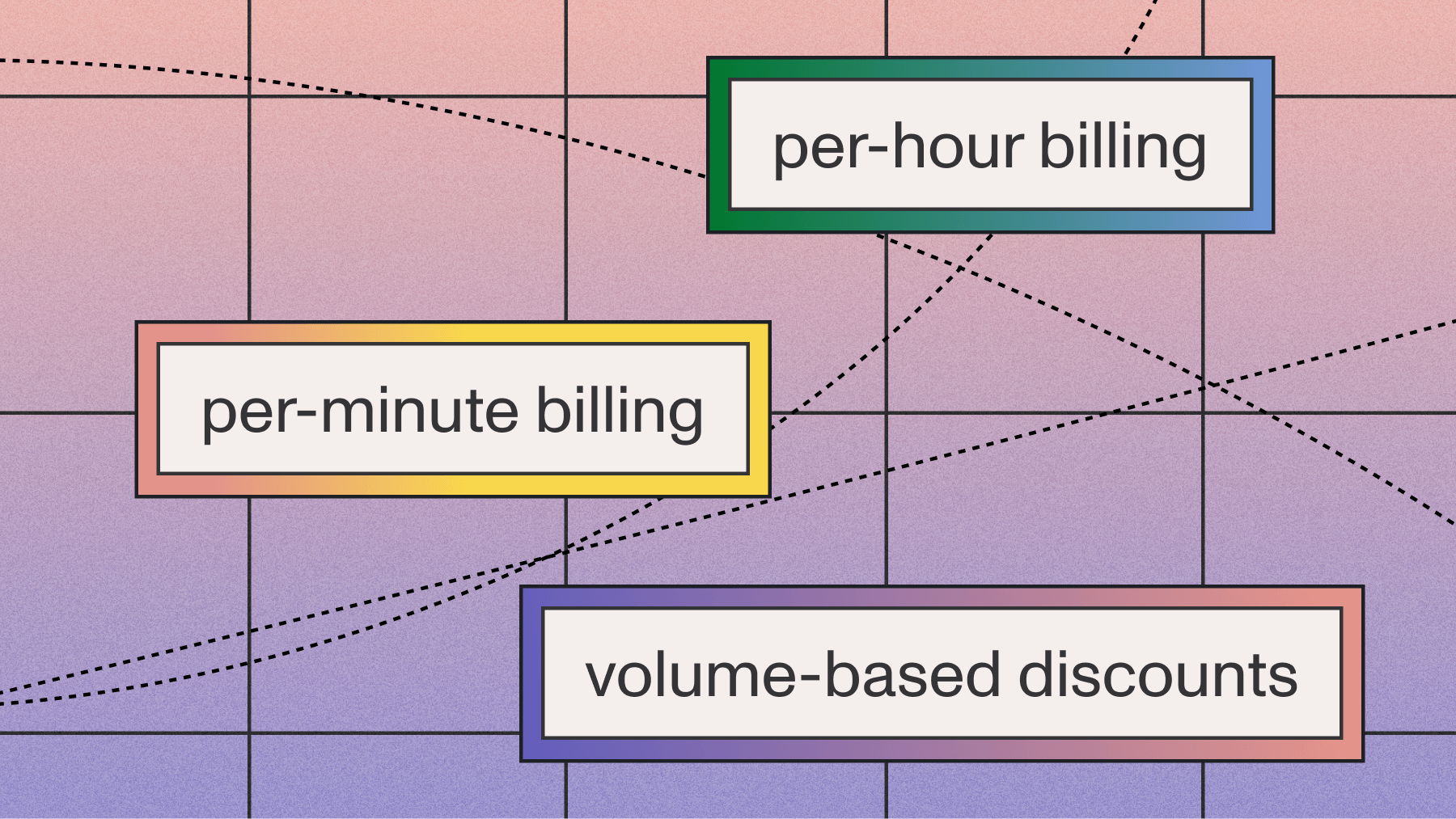
Speech-to-text pricing ranges from $0.004 to $2.00 per minute depending on features and volume. Pay-as-you-go works for variable workloads, while committed use discounts can cut costs significantly for predictable volumes.
Consider total cost beyond per-minute rates. Poor accuracy increases manual correction costs, and complex APIs require more developer time.
How to evaluate speech-to-text alternatives
A rigorous speech-to-text evaluation goes beyond headline accuracy numbers to measure how a model performs on your audio in your conditions. The most common metric is Word Error Rate (WER)—the percentage of words transcribed incorrectly—but WER benchmarks on clean audio rarely predict real-world performance.
The true test of any AI model is how it handles background noise, overlapping speakers, heavy accents, and industry-specific terminology. For instance, one study found that some commercial ASR systems had nearly double the error rate for speakers of African American Vernacular English (AAVE) compared to white speakers, highlighting the importance of testing on diverse, real-world audio. Always evaluate providers using a representative sample of your actual user audio before committing to a production integration.
Key evaluation criteria
When testing alternatives to Google Cloud Speech-to-Text, structure your evaluation around these core pillars:
Real-world accuracy
Test using your actual audio data, not sanitized benchmarks. Look for native handling of alphanumeric formatting, proper noun recognition, and punctuation in real-world conditions.
Latency and concurrency
Measure time to first byte and the model's ability to sustain hundreds of concurrent streams without degradation—critical for real-time applications like voice agents and live captioning.
Speech understanding capabilities
Determine whether the provider offers built-in features like speaker diarization, sentiment analysis, or an LLM gateway—or whether you'll need to stitch together multiple vendors to achieve the same result.
Developer experience
A well-designed API requires minimal configuration and offers robust SDKs in your preferred programming languages. Strong documentation dramatically reduces time-to-production.
Companies like Veed, Descript, and Krisp evaluate Voice AI infrastructure based on these exact criteria to ensure reliable performance at scale.
5 best alternatives to Google Cloud Speech-to-Text
1. AssemblyAI
AssemblyAI is a Voice AI platform that delivers industry-leading transcription accuracy through a single API. You get transcription, speaker identification, sentiment analysis, and content insights through a unified interface without managing multiple services.
AssemblyAI's pre-recorded models, like Universal-2 and the state-of-the-art Universal-3 Pro, handle batch processing, while real-time models like Universal-3 Pro Streaming process audio with minimal delay. Unlike Google's separate APIs for different features, AssemblyAI includes speech understanding capabilities in one unified interface.
AssemblyAI consistently outperforms Google Cloud on challenging audio—accented speech, technical terminology, overlapping speakers, and noisy environments. Developers report transcription accuracy improvements of up to 23% when switching from other providers, with the platform supporting a customizable number of speakers per recording and automatic language detection across 90+ options.
Core capabilities include:
- Real-time streaming: WebSocket API with sub-300ms latency
- Speaker diarization: Identifies who said what in conversations
- PII redaction: Automatically removes sensitive information for compliance
- LLM Gateway: A unified interface to over 20 models from providers like Claude, GPT, and Gemini, supporting not just summarization and Q&A but also advanced use cases like tool calling and agentic workflows.
- Custom vocabulary: Improves accuracy on industry-specific terms
AssemblyAI's documentation stands out with interactive code examples and migration guides. Developers report getting to production in under an hour when switching from Google Cloud.
Pricing starts at $0.15/hr for the Universal-2 model and $0.21/hr for the highest-accuracy Universal-3 Pro model. New users get $50 in free credits—enough to transcribe over 300 hours of audio with the Universal-2 model or approximately 238 hours with Universal-3 Pro.
2. OpenAI Whisper
OpenAI Whisper is an open-source speech recognition model you can run on your own servers. Self-hosting provides complete data privacy with no per-minute costs after initial infrastructure setup.
As research confirms, Whisper was trained on an enormous dataset of 680,000 hours of multilingual and multitask audio from the internet, which allows it to handle 99 languages without language-specific configuration. The largest model achieves impressive accuracy but requires significant computing resources—10GB of VRAM and processes audio slower than real-time.
Self-hosting Whisper requires technical expertise to manage GPU servers, implement queuing systems, and handle model updates. Many teams find the infrastructure overhead costs more than using hosted alternatives.
OpenAI also offers Whisper through their API at $0.006 per minute—the lowest commercial rate available. However, the API lacks real-time streaming, speaker identification, and word-level timestamps.
Choose Whisper when you need:
- Complete data privacy with self-hosting
- Batch processing without time constraints
- Multilingual support for uncommon languages
- The lowest possible per-minute costs
3. AWS Transcribe
AWS Transcribe integrates directly with Amazon's cloud services, triggering Lambda functions on completion and storing outputs in S3—simplifying security compliance and eliminating data transfer costs if your infrastructure already runs on AWS.
The service includes specialized models for medical transcription and call center analytics with industry-specific vocabulary. Custom vocabulary and speaker identification come standard, though the 10-speaker limit restricts some meeting transcription use cases.
AWS Transcribe performs well on clear recordings but struggles with background noise and overlapping speakers. The medical and call analytics models show improvement in their specific domains.
Pricing starts at $0.024 per minute for batch transcription and $0.030 for streaming. AWS Free Tier includes 60 minutes monthly for the first year.
4. Deepgram
Deepgram does well on uncomplicated audio but its model can struggle with real-world audio that has background noise and overlapping speakers.
The platform processes multiple audio streams simultaneously, with a cost upgrade, and maintains good accuracy on conversational speech.
Deepgram includes profanity filtering, number formatting, and smart punctuation in its base tier. Their WebSocket API supports dozens of concurrent connections for high-volume streaming applications.
Pricing starts at $0.0043 per minute and enhanced tiers with speaker identification and additional languages increase costs but remain competitive.
5. Microsoft Azure Speech Services
Microsoft Azure Speech Services provides voice capabilities within Microsoft's ecosystem—transcription, text-to-speech, translation, and speaker recognition—with seamless integration with Active Directory, Teams, and Office 365.
Custom Speech models can be trained on your specific audio data and terminology for improved domain accuracy. The Speech SDK supports extensive customization but requires more complex implementation than simpler REST APIs.
Real-time transcription works well for single speakers but struggles with overlapping speech. Batch transcription handles large volumes efficiently with automatic scaling.
Pricing follows an hourly model—$1.00 for standard recognition, $2.00 for real-time streaming. The free tier provides 5 hours monthly.
Pricing comparison of Google Cloud Speech-to-Text alternatives
True costs go beyond headline per-minute rates—accuracy differences might mean spending more on manual corrections with cheaper options.
Hidden costs to consider:
- Accuracy impact: Poor transcription quality increases correction time
- Integration complexity: Some APIs require more development work
- Feature limitations: Basic tiers might lack essential capabilities
Migration guide: switching from Google Cloud Speech-to-Text
For most applications, migrating from Google Cloud Speech-to-Text to an alternative takes under an hour—REST and WebSocket architectures across modern providers map closely to existing implementations. The steps below apply regardless of which provider you're switching to.
Step 1: Map your current features
Identify which Google Cloud features your application currently uses. If you rely on Google's separate APIs for transcription and NLP, you can often consolidate these requests. Modern alternatives typically return speech understanding data—like speaker labels and sentiment—in the same payload as the transcript.
Step 2: Update authentication and endpoints
Replace your Google Cloud credentials with your new provider's API keys. Update your request endpoints to point to the new service. For pre-recorded audio, this usually means swapping a Google Cloud Storage URI for a standard audio file URL or uploading the file directly through the new API.
Step 3: Adjust response parsing
Google Cloud returns a specific JSON structure. You'll need to update your application's parsing logic to handle the new provider's response format. Look for SDKs that provide typed responses, which significantly reduces the time spent mapping JSON fields.
Step 4: Test and deploy
Run your existing test suite against the new implementation. Pay special attention to edge cases like long periods of silence or highly technical conversations to ensure the new AI models handle them correctly before rolling out to production.
Which Google Cloud Speech-to-Text alternative is right for you
Your choice depends on your specific requirements, existing infrastructure, and the audio conditions your application will encounter. Here's how to match your use case to the right provider:
Why AssemblyAI is the leading Google Cloud Speech alternative
AssemblyAI achieves consistently higher accuracy than Google Cloud Speech-to-Text across standard benchmarks and real-world audio. This accuracy advantage comes from training on diverse, challenging audio rather than clean laboratory datasets.
The unified API design means you implement once and access all features—transcription, timestamps, speakers, sentiment, summaries—without managing multiple services. Migration from Google Cloud typically takes 30-60 minutes using provided migration guides and code converters.
Independent reviewers on G2 rate AssemblyAI at 4.8 out of 5 stars, with Quality of Support scoring 9.6—significantly higher than industry averages. Developers highlight implementation speeds of under an hour and cite the platform's intuitive interface, comprehensive documentation, and responsive support as key differentiators.
Companies switching to AssemblyAI report significant improvements in transcription quality, especially on accented English and technical terminology. The platform automatically scales to handle millions of minutes daily while maintaining consistent processing speeds.
Enterprise customers benefit from SOC 2 Type 2 certification and uptime guarantees, addressing what industry survey data identifies as a top-three challenge for product teams: data privacy and security. AssemblyAI enables covered entities and their business associates subject to HIPAA to use AssemblyAI services to process protected health information (PHI), with a Business Associate Addendum (BAA) available. AssemblyAI's infrastructure handles traffic spikes without degradation.
Getting started with your chosen alternative
Choosing the right Voice AI infrastructure is a critical decision that impacts your product's user experience and your engineering team's velocity. While Google Cloud Speech-to-Text offers a baseline service, modern applications require the superior accuracy, advanced speech understanding, and developer-first experience provided by specialized alternatives.
Whether you're building a meeting notetaker, a voice agent, or a media editing platform, evaluating models on your own data is the best way to make an informed decision. Look for providers that offer transparent pricing, comprehensive documentation, and models built on the latest AI architectures like Universal-3 Pro.
Ready to test industry-leading accuracy on your own audio? Try our API for free and see the difference in your transcription quality today.
Frequently asked questions about Google Cloud Speech-to-Text alternatives
Which speech-to-text API has the highest accuracy compared to Google Cloud?
AssemblyAI consistently delivers the highest accuracy across challenging audio conditions—accented speech, background noise, and technical terminology—with measurable improvements over Google Cloud across diverse audio types.
How much do Google Cloud Speech-to-Text alternatives cost per minute?
Alternatives range from Deepgram at $0.0043/min for basic transcription to AssemblyAI, which starts at $0.15/hr for its Universal-2 model with full speech understanding features—but factor in accuracy's downstream impact on correction costs before choosing on price alone.
Can these alternatives handle real-time speech transcription?
Yes—AssemblyAI Streaming delivers sub-300ms latency with higher accuracy than Google Cloud.
Is Google Cloud Speech-to-Text better than OpenAI Whisper?
They're optimized for different scenarios: Google Cloud performs better for real-time streaming and punctuation, while Whisper handles accented speech, multilingual audio, and noisy environments more reliably—though neither matches AssemblyAI's accuracy on production-grade audio.
How difficult is migrating from Google Cloud Speech-to-Text?
Basic transcription migrations take under an hour using provider-supplied guides, while applications relying on custom models typically require 1-2 days of development work.
Which alternative works best for speaker identification?
AssemblyAI's speaker diarization is highly flexible, supporting up to 30 speakers by default for longer recordings and configurable for more, significantly exceeding AWS Transcribe's 10-speaker limit.
Lorem ipsum dolor sit amet, consectetur adipiscing elit, sed do eiusmod tempor incididunt ut labore et dolore magna aliqua. Ut enim ad minim veniam, quis nostrud exercitation ullamco laboris nisi ut aliquip ex ea commodo consequat. Duis aute irure dolor in reprehenderit in voluptate velit esse cillum dolore eu fugiat nulla pariatur.